

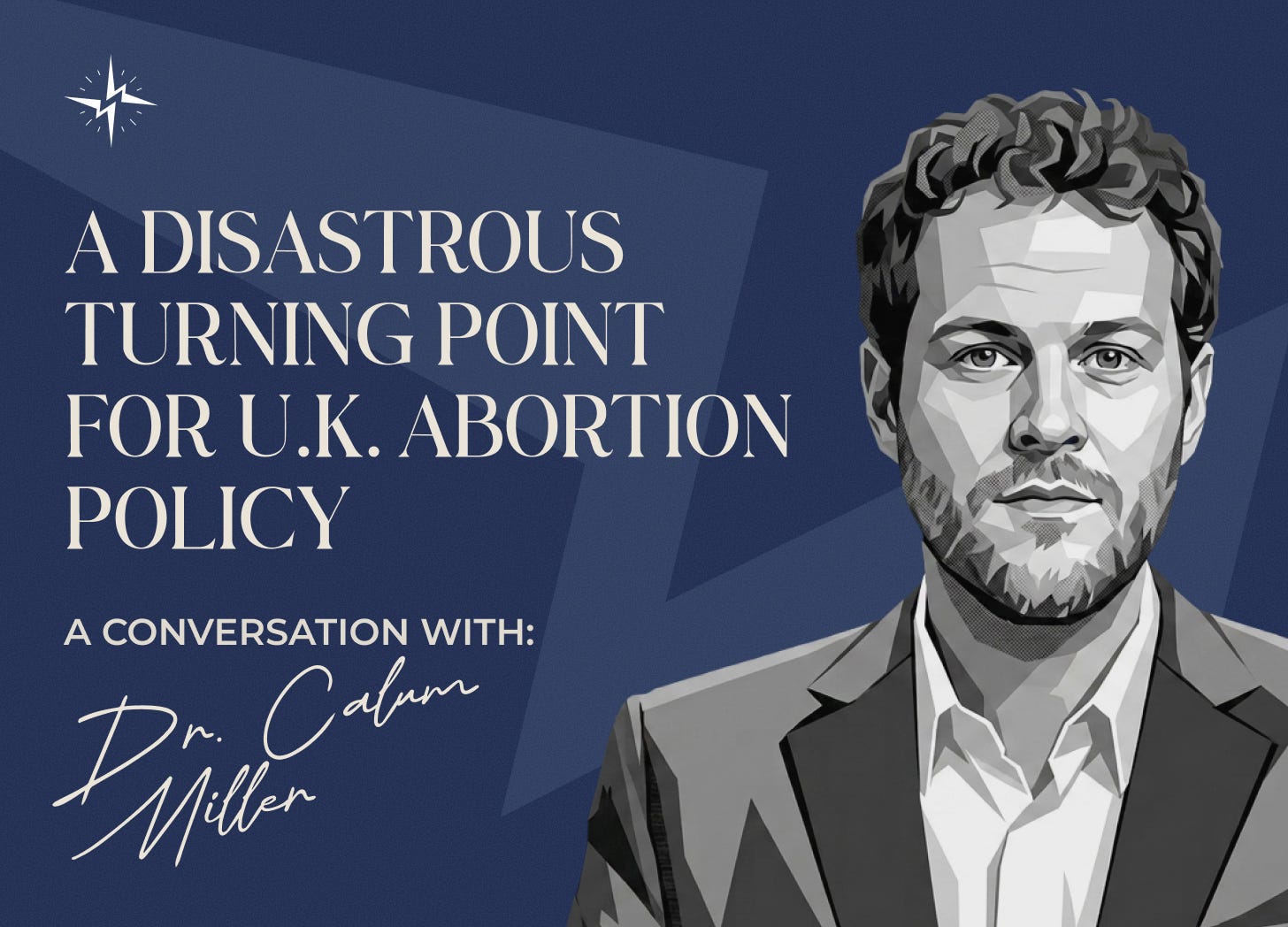
A Conversation with Dr. Calum Miller: A Disastrous Turning Point for U.K. Abortion Policy
Calum Miller examines a turning point in U.K. abortion law—and what it reveals about the West’s moral trajectory.

Last week’s House of Lords vote to decriminalize at-home abortions through birth raises urgent questions about law, medical oversight, and the worsening direction of life ethics in the United Kingdom.
Dr. Calum Miller currently works as a medical doctor in the U.K. He has published and presented numerous academic papers on medicine, law, philosophy, and ethics. His extensive work and expertise in the area of bioethics have led to multiple debates against the CEO of BPAS, the nation’s largest private abortion provider.
Why this conversation matters: This chat explores the real-world impact of the U.K. Crime and Policing Bill abortion amendment for abortion law, medical oversight, and ethical debate. If we wish to see Western culture restored, we must examine how we build a culture that protects the most vulnerable, from the womb to natural death, and the role that law plays in shaping that vision.
This interview has been edited for clarity and brevity.
THE CONVERSATION
RtW: As a medical professional working in the U.K, can you help us understand what the recent amendment to the Crime and Policing Bill actually does in practice, and why you believe it matters?
Miller: The current law allows abortion up to 24 weeks, nearly six months, for virtually any reason in practice. It is one of the most extreme laws in the world already. This amendment goes much further in allowing women, but not doctors, to perform abortions on themselves for any reason up to and during birth. So it is both profoundly medically reckless as well as morally barbaric. Almost no one outside Westminster thinks this is a humane law—most pro-choice people I speak to are appalled and consider this amendment to be murder. I don’t think they are wrong.
RtW: From your perspective as a doctor, what are the most significant medical, ethical, or societal implications of effectively decriminalizing abortion in the context of at-home procedures, particularly later in pregnancy?
Miller: It is obviously ethically abhorrent—this is a fully formed, viable baby capable of feeling pain, recognizing his or her mother’s voice, and everything else a newborn baby can do. We can keep babies born at 22 weeks alive in hospitals now, so the idea that we would allow babies almost twice their age to be aborted just because they are still inside the womb is unconscionable. But at-home abortions are also profoundly dangerous for women. Skilled birth attendance is one of the most basic provisions to reduce maternal mortality in the global south. This abortion-until-birth provision effectively incentivizes women to give birth to a full-term baby with no medical supervision, and if it comes out alive before dying, the mother can be prosecuted for murder, as well. The medical bodies pushing for this change bear none of these consequences.
“This abortion-until-birth provision effectively incentivizes women to give birth to a full-term baby with no medical supervision, and if it comes out alive before dying, the mother can be prosecuted for murder, as well.”
RtW: Supporters of the amendment argue that it doesn’t fundamentally change abortion law in the U.K. but rather removes the threat of criminalization for vulnerable women. How do you respond to that claim?
Miller: The argument is fundamentally dishonest. Currently, it is not legal for a woman to end the life of her unborn baby between 24 weeks and birth. But if the amendment becomes law, it will. That is obviously a change in the abortion law. The fact that it doesn’t change the law for everyone does not mean the law is unchanged. Making it legal for some people, but not everyone, to commit robbery is obviously a change in the law. The same applies here. Only this change in the law is even more objectionable than legalizing it for doctors as well— it means full-term abortion is legal, but only legal if a medically untrained mother performs it on herself. It is both cruel and dangerous, not merely cruel.
RtW: What do you think this shift means in practice for clinical standards, safeguarding, and the role of medical oversight? Are there specific risks or changes you believe policymakers and the public may be underestimating?
Miller: As I previously mentioned, skilled birth attendance is one of the most basic provisions in the developing world to prevent maternal deaths. But this law effectively incentivizes women to give birth to a child at full-term with no medical supervision at all. The abortion industry and their parliamentary allies have already recklessly supported pills by post, which allows women to obtain abortions without ever seeing a medical professional or obtaining an ultrasound in person. This lack has caused countless harms to women. I personally know someone in the U.K. whose sister died because of this dangerous policy. But in the law and among the abortion industry, abortion is treated unlike any other medical procedure. All safeguards are secondary to the goal of doing abortion as quickly and seamlessly as possible.
RtW: Looking ahead, where do you think this development takes us as a society, both in terms of how we understand abortion and protect both women and unborn children? What do you think needs to happen next?
Miller: It is a misstep from the abortion industry. Not just because it is barbaric and dangerous, but because I have never seen this much backlash to abortion among mainstream commentators, the public, and political figures in the U.K. Until this past year, I had never seen a major political party try to win pro-life voters; now we have at least three parties condemning this amendment and two promising to repeal it. We have seen some of the most well-known feminists beginning to sound pro-life. Opinion polling shows that the youngest generation of men is 300% more pro-life than the oldest. This was a settled issue. Now it is not. That is great news.
THE BOTTOM LINE
The battle for a culture of life in the U.K. is far from over, with growing signs that public opinion is diverging from political decision-making. As legal changes reduce safeguards, concerns remain about increased vulnerability to coercion and harm, particularly for women. This turning point reinforces the need to rebuild a culture that safeguards the dignity of every human life.
 | A guest post by
|
This is a barbaric proposal, and I know no-one who supports it. What have we become, and why?
Wow. So right in the middle of all the child rape scandals, sanctioned by their own police and govt, this THIS they thought would be a good idea?! Really?! Well, it sure makes it a hell of a lot easier for the rapist (and all his cousins 🤢) to kidnap more little girls and then murder the evidence of a child. I'm just so over it. Someone needs to step up and handle this. It's waaaay beyond.