

Ayaan Answers: Why the Christian Vision of Family Matters
Ayaan Hirsi Ali discusses how faith, family, and moral responsibility form the cultural bedrock of the West.


In this conversation for Restoring the West’s Faith and Family pillar, Ayaan Hirsi Ali examines why the Christian understanding of family is central to renewing Western civilization.
Ayaan Hirsi Ali is Founder of Restoring the West and a leading writer on freedom, religion, and Western civilization. After fleeing Somalia to escape a forced marriage, she built a life in the Netherlands and served as a Member of Parliament. Her journey from Islam to atheism and ultimately to Christianity shapes her perspective on faith, family, and the future of the West.
As Restoring the West launches its Faith & Family pillar, this conversation explores why the family, rooted in the Judeo-Christian moral tradition, is foundational to free societies. Ayaan reflects on how faith, marriage, and moral formation sustain the cultural and civilizational foundations that make Western freedom possible.
This interview has been edited for clarity and brevity.
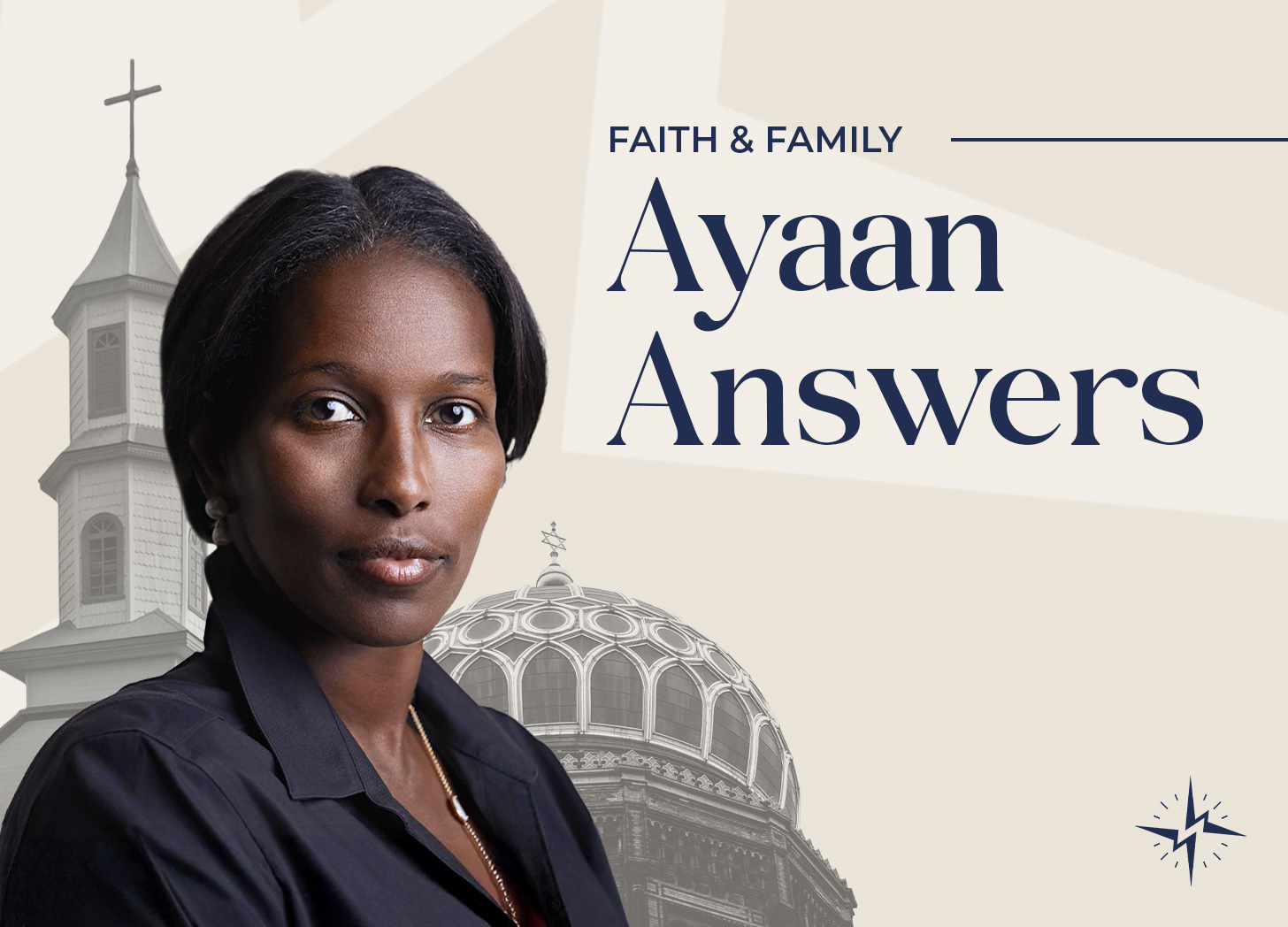
RtW: Since fleeing Somalia and building a life in the West, how have your views on the family evolved and how do you see the relationship between religion, family and the preservation of freedom?
AHA: My views on the family have evolved significantly since coming to the West. When I was a Muslim, I saw family as the most important unit in society. Beyond the individual, then, the next most meaningful collective is the family.
My attitude to family was shaped in the Islamic context, where a family is formed at marriage. In my early years, marriage was [never] the question of if, it was only a question of when. My only problem with my Islamic upbringing was that I wasn’t allowed to choose my husband.
After moving to the Netherlands and living there for fourteen years, I adopted the prevailing view that starting a family doesn’t necessarily require getting married. Two people can freely choose each other, live together, and raise their children.
RtW: You have first-hand experience of family structures in other cultures, such as Islamic Forced Marriage. Why is the Christian vision for family so remarkable and a bedrock for Western civilization?
AHA: As a Muslim, I was not allowed to choose my own husband. My father was my guardian, and if I got married, [he] would be my guardian. In the Christian tradition, the man and the woman are equal before the eyes of God, and both of them are created in the image of God. Having children is not instrumental either, unlike in the Muslim household, where you have to have as many as possible–especially boys–so that they can fight for your clan.
Yusuf al-Gharadawi says to use the mother’s womb to conquer. It’s quite the opposite of what Christianity preaches. In Christianity, you bring forth life, which is the most sacred thing in the eyes of God. You shape that life, protect it, feed it, and do everything to ensure the best possible conditions for it.
Christianity teaches that parents do not own their children, but instead guide them to follow God’s laws. One of the biggest differences I noticed between Christian and Islamic teachings is how children develop their conscience.
In Islam, your conscience comes from outside, so family members use social pressure to make you do what is right. In Christianity, parents are supposed to help their children build an inner sense of right and wrong, teaching them that they answer to God and that these values are their own.
Islam and Christianity disagree on many things in terms of what is right or wrong. That is, if you want to understand Christian morality I often point to the example I like most, Christ’s Sermon on the Mount. Also, the Old Testament part of it is the Decalogue, the Ten Commandments. Almost everything that the West has produced, morally speaking, is inspired by that.
“For the West to restore itself, it has to rediscover and revive its biblical roots.”
RtW: How would you respond to conservatives who affirm the importance of the family but do not subscribe to the Christian faith? Can the West still be restored by families committed to traditional values if those values are not grounded in religious conviction?
AHA: I like Os Guinness’s analogy of the cut flower civilization. I find it very vivid in regard to non-Christian conservative parents. Conservative non-Christian families are cutting themselves off from our foundational roots.
Let’s think about what happens to a plant when the roots die. What happens when you pick flowers and put them in a vase? Obviously, the flowers wither. And if you cut conservative morals off from Christianity, they fade.
This decline is exactly what we have seen in the West over the last century and a half. Some people say the decay dates back to the Enlightenment. It’s a gradual fading that goes on and on. My fear is that we have landed in a place of moral wilderness.
For the West to restore itself, it has to rediscover and revive its biblical roots. I insist that the biblical roots matter most, morally and spiritually. If our moral and spiritual roots in the Bible are cut off, we’re asking for a great deal of trouble. Christianity is the only religion that can rejuvenate the West because of the freedom of conscience it preaches. It does not demand or impose on individuals that they must actually believe in God. You’re encouraged to have faith, you’re invited to come to Christ.
But if you say, “I reject Christ because I can’t see him, I see no evidence,” there are no consequences at all. The state is not going to imprison you, your family is not going to reject you, at least they should not, that would be very unChristian. So Christians are allowed to encourage Christianity in others, but they’re not allowed to impose, as faith is a matter of conscience. You cannot pretend to believe when you don't, but the foundational principles and morals are biblical.
RtW: Marriage is on the decline. Who has a part to play in showing young people that marriage is a valuable life decision, worthy of sacrificing individualistic aspirations?
AHA: Several institutions are responsible for this timely job. And obviously, it starts with the parents and parenting. The next institution is schools, and then universities. Then there is the church and moral associations as an institution. And then, of course, at the very end is the state, which protects individuals and families.
And sadly, I see a profound decline in all of these institutions. Terrible parenting. Schools are completely subverted and no longer doing what schools are supposed to do, transmit knowledge. In fact, the schools are doing the opposite. They’re telling us our society and our civilization are rooted in badness, in exploitation, in white supremacy.
So they’re actually committing a crime against their own civilization. The purpose of schools is to build and shape character. However, if you look at Gen Z, they’re being told that they are victims, they need therapy here, therapy there, and they’re being nannied. The shaping of character is not the school’s responsibility.
The churches have become so watered down that it’s hard to know what they truly stand for. Many churches have drifted away from the Bible. They’ve made up their own thing. They’ve adapted to culture so much that you wonder if they are Christian at all.
RtW: As a mother, what impact has Christianity had in your own family life? What kind of fruit can converts to Christianity expect to see in their families?
AHA: First, Christianity has given my family and me a strong spiritual and moral foundation. When I was an atheist, I used to tell my older son, “This is what I think is right and wrong, but when you turn eighteen, you can decide for yourself.” Now, I try to raise my children with the moral and spiritual teachings of the Bible. We read the Bible together, go to church, and try to understand its lessons. This has given us a sense of purpose and meaning, and my relationships have improved because of it.
Before, if I got angry or resentful or bitter, there was nothing to stop me from wallowing in all of those things. And now I pause and think to myself, “Is this really who I am? Is this what God wants for my family and me?” I immerse myself in these concepts of forgiveness, redemption, and all the good things that make having a relationship with other people so much easier and more peaceful. Through this change, I’m finally finding peace within myself and am able to offer that same peace to those around me.
THE BOTTOM LINE
Ayaan Hirsi Ali warns that the West risks drifting into a “moral wilderness” if it abandons its biblical roots. The Christian vision of family, formed by marriage, moral responsibility, and freedom of conscience, has long sustained Western liberty. Restoring these foundations, she argues, are essential if the West is to reclaim the moral and spiritual roots that made its freedoms possible.
 | A guest post by
|
Very Helpful and useful It is one thing to know what has been going on It is another thing a Gift to be able to articulate it so well, in an interview. To convey the gist in a few words. Great
Ayaan is a wise woman. Thank you for your thoughtful assessment. 🙏🏼🩷