

Frozen and Forgotten: The Moral Failure of IVF
When human life is treated as inventory, every downstream “solution” risks deepening the injustice rather than resolving it.

The argument: Embryo adoption does not resolve the central problem: IVF generates overwhelming numbers of surplus embryos that cannot be cared for, leaving many indefinitely frozen, neglected, or destroyed.
WHY IT MATTERS
Across the United States, an estimated 1.2 to 1.5 million human embryos remain frozen in storage, waiting to either be adopted or to simply “expire”. It is a quiet bioethical crisis that raises more questions than answers. For those committed to the sanctity of life, the question is no longer abstract: what do we owe to these human beings, and how did we allow their creation in such numbers? The moral credibility of the pro-life movement depends on confronting the cause of this phenomenon head on with a clear path forward.
I have been captured this week by the story of Hannah Strege, a young woman who has shared her powerful and deeply moving journey of being rescued by her parents out of storage. Her life is a gift, and it is right to give thanks that she was not left indefinitely in frozen storage. Influenced by voices such as Dr. James Dobson and institutions like Focus on the Family and the Lutheran Church–Missouri Synod, her adoptive parents concluded embryo adoption was the moral path forward. Stories such as this make us ask the question: what is our moral obligation to these forgotten human lives?
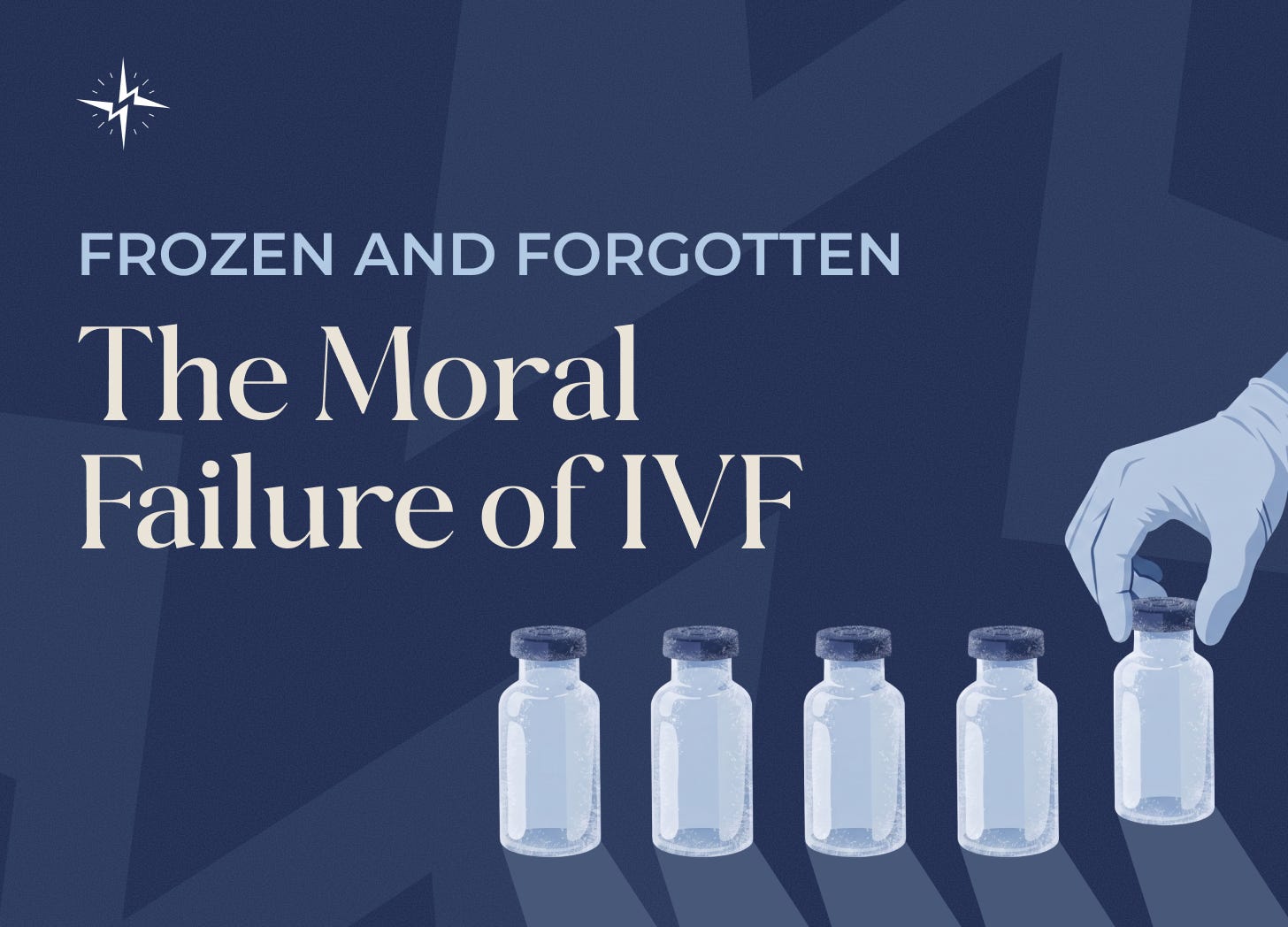
The IVF industry routinely produces more embryos than will ever be implanted, leaving vast numbers indefinitely cryo-preserved. These embryos—human lives at their earliest stage—are legally treated not as people but as property, transferable through contracts often costing only a few hundred dollars. This commodification is not incidental, but rather intrinsic to the system. Even when pursued with sacrificial intentions, or when the process helps a family struggling to conceive finally achieve parenthood, embryo adoption signals that there is a “market” for excess embryos, thereby incentivizing their continued production. A system that begins by manufacturing surplus human beings cannot be morally corrected simply by redistributing them.
Supporters of embryo adoption argue that it offers a pro-life response to an existing tragedy. But we have to ask whether this is truly responding to injustice, or participating in its logic. It is a real and pressing question what we are to do with the overwhelming number of embryos left in storage. Yet IVF is built on the idea that reproduction should be managed and, in some sense, commercialized. Downstream of this, we vehemently reject the buying and selling of human beings in all other forms. But at this earliest stage, when life seems less obvious to us, we accept it. The question is whether embryo adoption keeps that door open, when the answer should be to close it at the source.
The deeper issue is cultural. A society that accepts IVF as normative has already conceded that children can be produced, managed, and distributed according to adult desire. Restoring the West requires recovering a vision of human dignity grounded not in autonomy or technological capability, but in the inherent worth of every person from conception. This means rejecting practices that fragment procreation from its natural and moral context, and instead promoting ethical alternatives such as restorative reproductive medicine and the adoption of children who are born and are waiting for a home.
THE BOTTOM LINE
Hannah Strege’s life—along with the many other cases of people born as a result of embryo adoption—is a miracle for which we should give thanks. But we cannot allow exceptional stories to normalize a fundamentally unjust system. The Christian response is not to manage the consequences of IVF, but to end the conditions that create “spare” human beings in the first place.
 | A guest post by
|
I am deeply struck by my past blindness to the commodification of human embryos. Now I feel the need to rethink and, in fact, reverse my previous view of IVF.
This is indeed akin to the problem of ransoming slaves, which incents the slavery system to continue.
This problem is even simple to solve however; let the infertile potential adopters make themselves known to crisis pregnant mothers whose baby is already conceived. The main moral problem of IVF is the conception in the Franken tube in the first place. Infertile couples tempted to IVF should instead put themselves at the service of the orphans already conceived.