

If You Want Readers, Start with Better Books
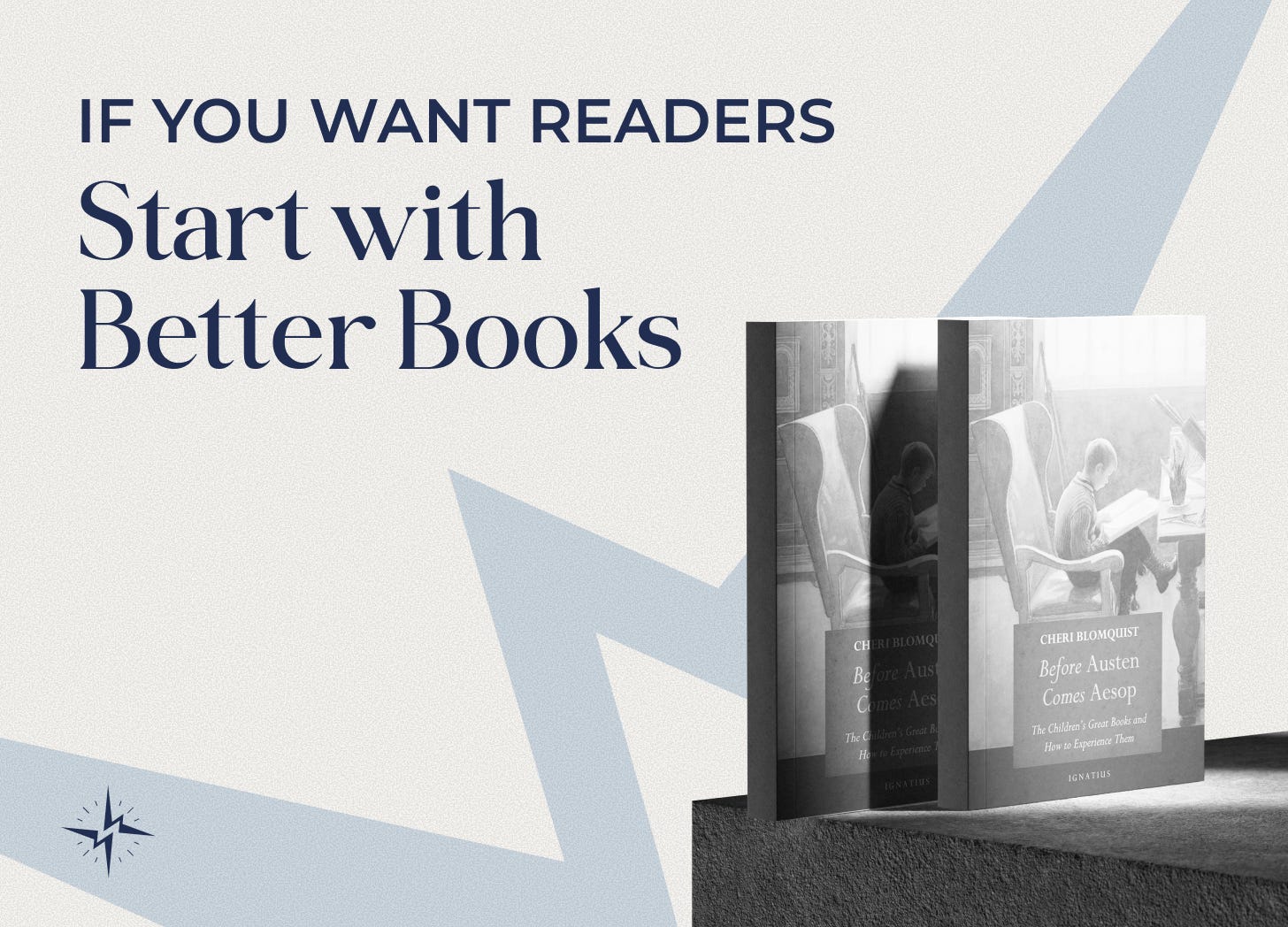
Before Austen Comes Aesop tackles an essential topic: what should children read to prepare them for the Great Books of Western civilization?

Book: Before Austen Comes Aesop: The Children’s Great Books and How to Experience Them
By Cheri Blomquist, Ignatius Press, 2021 • 272 pages
The verdict: Learning to love good literature is a necessary step toward lifelong reading, understanding, and developing the moral imagination, and Blomquist’s work sets students on the right path.
WHY THIS BOOK MATTERS
Americans are reading less, and today’s students lack both the preparation and interest to reverse the trend. Lack of phonics instruction is part of the problem.
But another issue is that students are rarely assigned whole books—and when they are, the choices are often dull. This path kills students’ interest in reading before it ever begins. Young children who find that reading is boring will grow into adults who never crack open a book.
THE ARGUMENT
Blomquist argues that children should read great children’s literature before jumping into adult Great Books. In Before Austen Comes Aesop, she examines “the literature that has made the most profound impact on the lives of children throughout Western history.” The book is divided into two parts: “The Children’s Great Books” ( more on that later) and “Your Passport to Three Reading Adventures.” These “adventures” guide teachers and students through various approaches to teaching and enjoying literature, from book clubs and reading journals to more formal assessments. Also included is a useful appendix.
Blomquist’s list of recommended works begins with ancient times and ends with the late 20th century, and it distinguishes between foundational works that should be prioritized and those that should only be considered. She includes a short synopsis of each work as well as some related virtues and themes. In addition to Aesop’s Fables (a must!), some of the important works on the list include the Bible, ancient mythology, Homer (adapted for children), nursery rhymes, legends (e.g. Robin Hood and King Arthur), Grimm’s Fairy Tales, Winnie-the-Pooh, and The Chronicles of Narnia.
WHAT WORKS
Blomquist’s basic premise is sound. Students should read Aesop (and a great many other works) before they are ready for Pride and Prejudice. Parents and schools should provide students with time-tested books, poems, and essays that feed the moral imagination—but keep them accessible to children.
Moreover, her list of recommended works, focused on a “Western Canon” for children, is mostly excellent. (Although I was surprised to see Rosemary Sutcliffe’s excellent retellings of The Odyssey, The Iliad, and Beowulf omitted, while some very obscure works from the Middle Ages were included.) Unlike many popular children’s book lists, it intentionally starts with books from ancient times through the early Middle Ages. She also digs deep. For example, instead of offering just one version of the Norse myths, she lists several, in order of maturity from middle grade to adult.
WHAT DOESN’T
Before Austen Comes Aesop addresses a narrow audience: the small number of parents or teachers who introduce difficult material too early, rather than the growing number of parents or educators who never introduce quality literature at all. The introduction makes this clear: Blomquist tells her own story of loving literature until asked to read Jude the Obscure in high school. But today, this experience is far from common. Most schools expect too little instead of too much from their students. Many don’t even assign whole books. While Blomquist’s list still applies to these schools and students, her framing of the issue will be alien to them.
THE BIGGER PICTURE
Kids need books that connect them to truth, goodness, beauty, and tradition—but also a clear progression that builds toward more demanding works. Without that foundation, later encounters with the Great Books feel inaccessible or irrelevant. A coherent children’s canon introduces enduring stories, shared references, and moral questions that shape both literacy and cultural understanding.
Today, many students read fragmented excerpts or forgettable contemporary texts, weakening both skill and shared knowledge. Restoring time-tested children’s literature is a practical way to reverse that trend. Students nourished by fables, myths, and classic stories are far better prepared to engage seriously with the broader Western tradition, and far more likely to become lifelong readers.
THE BOTTOM LINE
From Austen to Aesop is a good starting place for teachers or homeschool parents looking to build a serious curriculum or home library of children’s literature. It is a beautiful invitation to take the first steps into great children’s literature.
 | A guest post by
|
Yes, parents and teachers need to hear this. My parents read to me, and they had books in the house and read themselves. I used to love the Scholastic Book Club in school, where we could read a brief description in a catalogue and then order very affordable perbacks each month. I was so excited when the order arrived. I just checked Scholastic Book Club for kids today, and is it me or do the books seem to have less attractive covers, darker themes and a lot of racial and sexual orientation themes instead of more universal ones vis-a-vis the vintage ones. The vintage ones (also searchable) I'd want to read even now; less so the current offerings.
My son and his wife have read to their daughter every day since the day she was born. She is now two-and-a-half and knows the lines before they are spoken. She 'reads' picture books (no TV during the week and limited to a couple of hours cartoons on the weekend) and will soon be reading herself, impatient that she can't read by herself now.