

Pornography is Destroying Our Hearts and Our Culture
The industrial scale, coercion, and cultural consequences of modern pornography prove it is far from a harmless private indulgence.

Book: Pornocracy
By Jo Bartosch and Robert Jessel, Polity, 2026 • 192 pages
The verdict: Pornocracy is a deeply unsettling but necessary book that convincingly exposes pornography as an exploitative system that demands far greater public attention.
WHY THIS BOOK MATTERS
Jo Bartosch and Robert Jessel intervene at a moment when pornography is more accessible, normalized, and technologically embedded than ever before. Rather than relying on explicitly religious arguments, they assemble secular, empirical evidence to challenge the assumption that pornography is benign. The book addresses a broad audience, especially the indifferent or uncritical consumer, and raises alarm about the formative impact on children growing up with smartphones. Its central concern is cultural: how an entire generation is being shaped by an industry operating with minimal scrutiny.
THE ARGUMENT
The authors argue that modern pornography functions as a highly addictive, algorithm-driven system that escalates users toward increasingly extreme material. What begins as casual consumption can lead to desensitization, with platforms recommending content involving violence, degradation, and simulated underage scenarios. Drawing on studies and large-scale analyses, they claim that such content is not marginal but dominant, with high proportions depicting aggression toward women. Crucially, Pornocracy contends that online consumption does not remain confined to the screen. It correlates with shifts in sexual behaviour, expectations, and, in some cases, criminal trajectories. The authors emphasize the opacity of the industry, both financially and operationally, arguing that its true scale and harm remain deliberately obscured. The result is a system in which users themselves become commodified, echoing critiques of digital capitalism.
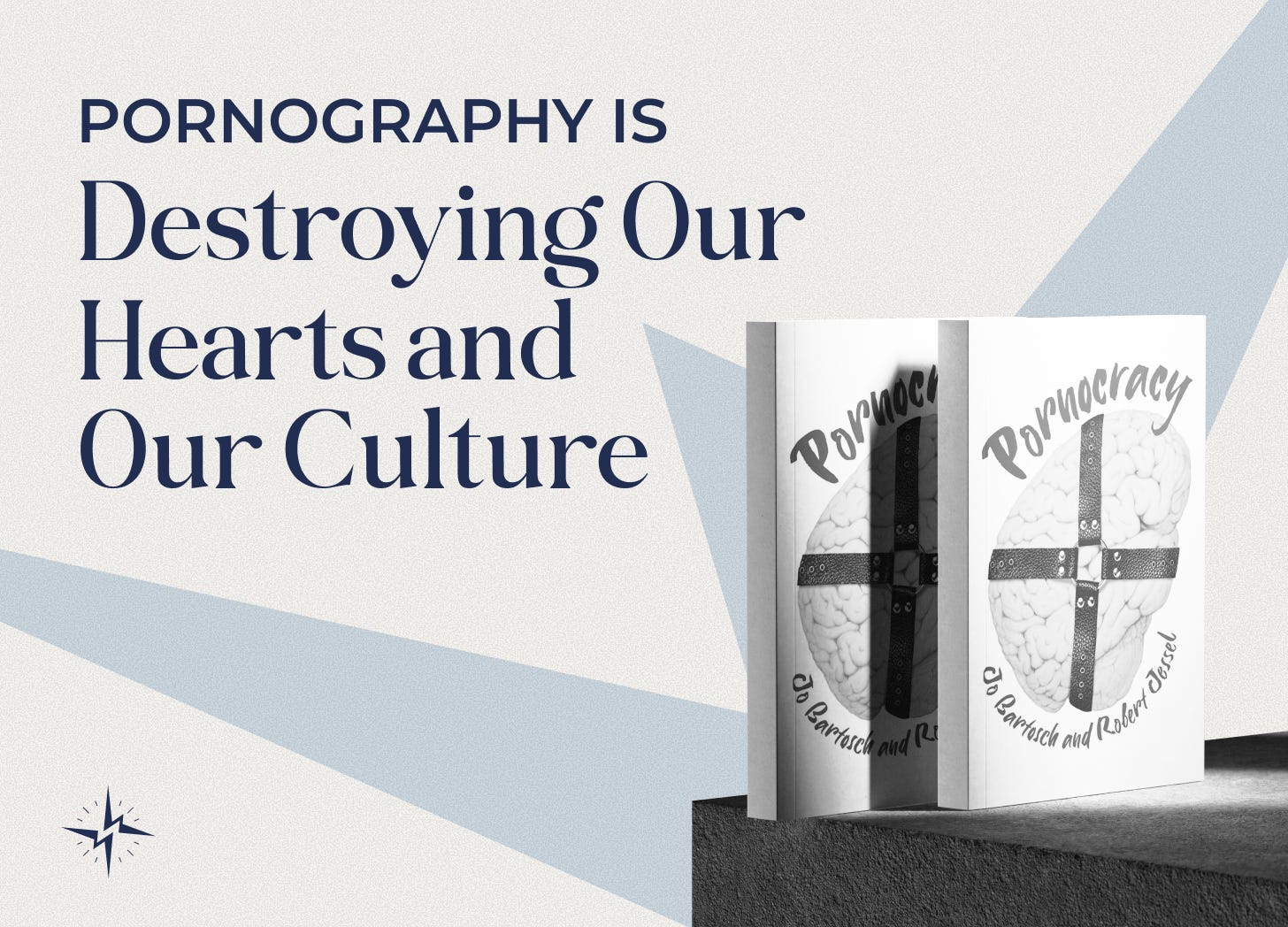
The book adopts an investigative, evidence-led approach, combining social research, media analysis, and cultural critique. It opens by contrasting earlier forms of pornography with today’s algorithmically amplified, increasingly violent content. Subsequent chapters explore themes such as addiction, gender relations, and the economic structures underpinning the industry. The argument is cumulative: case studies, statistics, and cultural observations build toward a systemic critique rather than a purely moral one.
“Life under the Pornocracy is eroding what pushes ordinary people to greatness: our willingness to make ourselves vulnerable by falling in love.” - Bartosch and Jessel, Pornocracy
WHAT WORKS
Pornocracy does not just gesture vaguely at the harms of pornography; it names them, documents them, and shows their scale with sobering clarity, drawing on deeply disturbing data to show how far the industry has shifted.What is particularly striking is their analysis of how pornography is reshaping the relationship between men and women. In the chapter “Pulled Apart by Porn,” they show how an entire vision of the opposite sex is being eroded, replaced by domination and control. They touch on the impact of Andrew Tate in this space, who they claim teaches his young followers “that to be a man is to be in total control.” These sentiments thrive and grow in a pornified culture. What pornography forms in private, voices like Tate then articulate in public. The result is not just damaged individuals, but a breakdown in the mutual dignity necessary for love, relationships, and ultimately marriage itself.
WHAT DOESN'T
Where the book is less persuasive is in its limited articulation of a positive alternative. While its diagnosis is powerful and convincing, its solutions—largely legislative—feel insufficient to match the scale of the problem. If pornography is destructive, there must also be a clear vision of sex as something rooted in love, dignity, and human flourishing. Without this, the critique lacks a constructive horizon. The authors show how the Pornocracy deforms individuals and society, but they say less about how we rebuild—particularly for a generation shaped by it from a young age. This is understandably beyond the scope of one book, but for restoration to happen, our society needs to be told a better story about love, relationships, and marriage.
THE BIGGER PICTURE
Within the broader question of Western cultural renewal, Pornocracy functions as a diagnostic text. It reveals how technological systems, market incentives, and cultural narratives converge to reshape fundamental human experiences: intimacy, desire, and relationships. The book does lead us to understand that any project of restoration must grapple not only with economics or politics, but with the moral ecology of everyday life. It exposes a tension at the heart of modern liberal societies between the language of freedom and the realities of exploitation. In doing so, it highlights the urgent need for a deeper renewal of our culture and moral vision.
THE BOTTOM LINE
This is essential reading for anyone concerned with the direction of our culture. It confronts the reader with the deeper erosion of love, desire, and human dignity in a pornified age. What it offers is not a full solution, but a necessary reckoning with the consequences of a freedom detached from truth.
 | A guest post by
|
True. Pornography can lead to desensitization. But we live in a desensitized world. If a doctor’s priority is to euthanize a healthy depressed patient (16 thousand patients were euthanized in Canada alone in 2024) instead of trying to help him by offering a good book to read or a glass of whiskey, not to mention decocking 10 year old kids cause they believe they’re in a wrong body, then pornography seems to be the least of our problems.
The article on this subject that I have been waiting for! I worked in youth mental health. Pornography was widely used, and at the epicentre of problems involving sexual violence and coercion, body shaming, bullying and rape culture.