

The War on Natural Birth
The rise in Caesarean births cannot be explained by maternal health alone, and it reflects a deeper cultural shift in how we understand pregnancy and the female body.

Responding to:
“Recent changes in caesarean birth rates in England” by the National Perinatal Epidemiology Unit; Published by Nuffield Department Women’s and Reproductive Health on June 8, 2026
The core disagreement: The report rightly identifies medical pressures, but overlooks how birth itself has increasingly been redefined from a normal physiological process into a medical event requiring management.
WHAT THEY GOT RIGHT
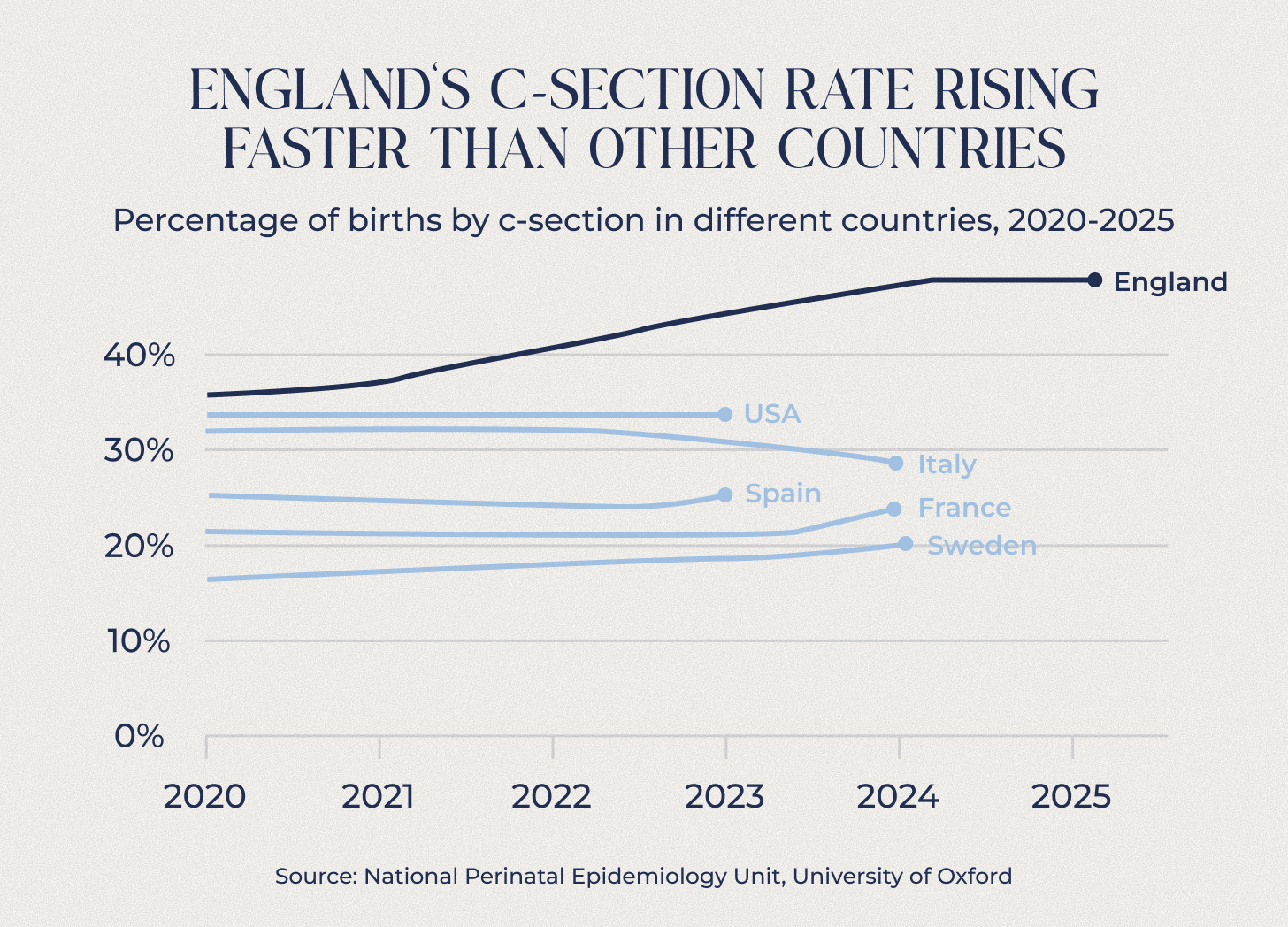
The report is right to highlight the scale of this change. England has climbed from 14th to 9th out of 42 comparable countries for Caesarean births in just five years, with other nations not experiencing such sharp increases. Rising maternal age, obesity, diabetes, IVF pregnancies, and repeat Caesarean sections undoubtedly contribute to a greater complexity of cases. It is also right to recognize mounting pressures on maternity services, including a growing culture of fear among clinicians shaped by litigation and high-profile maternity scandals.
WHERE THEY GO WRONG
The report assumes that rising intervention is simply the inevitable consequence of changing maternal health. It never asks the more fundamental question: should birth itself now be so medicalized? For thousands of years, women have given birth primarily through physiological labor, with medical intervention reserved for genuine complications.
A higher intervention rate is not, by itself, evidence of better maternity care. Medicine should respond to pathology, not gradually redefining normal biological processes as problems requiring routine management, something that can arguably be seen much earlier on in the fertility cycle with the continual pushing of contraceptives on young women. Good maternity care should begin with confidence in the healthy female body, offering continuity, patience, and skilled support while remaining ready to intervene when genuine complications arise.

The medical explanations are real, but they are incomplete. They do not explain why intervention rates have also risen among women with otherwise low-risk pregnancies, nor why Caesarean rates vary significantly between hospitals caring for similar populations. More broadly, Western culture increasingly assumes fertility requires laboratories, childbirth requires surgery, breastfeeding requires technology, and aging requires correction. The underlying message is subtle: nature is unreliable, while technology is inherently safer. Medicine is a remarkable gift, but when it becomes our default response even to healthy physiological processes, we rapidly lose confidence in the body’s ordinary capacity to function well.
THE REAL STORY
The real story is not simply that pregnancies have become more complex, but that our understanding of birth has fundamentally changed. We increasingly approach labor as a problem to manage rather than a natural process to accompany. Technology, while one of medicine’s greatest gifts, is at its best when it serves the body’s physiology rather than replacing it. Good maternity care requires the confidence to resist fear-driven decisions and to accept that birth is inherently slow, unpredictable, and cannot always be made efficiently. When institutions lose their tolerance for uncertainty, intervention naturally becomes the default. If we cannot recover trust in the healthy female body, technology will continue to shape birth in its own image, and we risk forgetting that medicine exists to support nature, not to supersede it.
“Good maternity care should begin with confidence in the healthy female body, offering continuity, patience, and skilled support while remaining ready to intervene when genuine complications arise.”
WHY THIS MATTERS
Caesarean sections save the lives of mothers and babies every day, and they remain one of modern medicine’s greatest achievements. The danger lies not in the operation itself, but in allowing technological solutions to become our instinctive response to every aspect of human life. A civilization that no longer trusts healthy bodies to do what they were created to do risks losing something deeper than natural birth; it risks losing confidence in human nature itself. Restoring confidence in physiological birth, while fully embracing life-saving medicine when needed, should not be seen as contradictory, but complementary.
THE BOTTOM LINE
Medicine should restore nature when it fails, not quietly replace it when it is functioning as designed. The question is not whether Caesarean sections are good, but whether we have become too quick to believe that technology is always safer than the remarkable wisdom of the healthy human body.
 | A guest post by
|
Two more reasons. In the U.S., at least, providers are paid far more for a Caesarean than for a natural birth. Also, natural births used to be abetted by midwives or nurses, primarily females. Doctors, primarily males, perform Caesareans, thus appropriating what used to be a female function. Same old story.
Sheila Kitzinger's book "Rediscovering Birth" is very good. It compares medicalised and traditional birth patterns. The photos of a hospital where all caregivers are looking at a machine compared to traditional midwifery where all the caregivers are looking at the mother, observing the mother, are very powerful to me. The highly medicalised birth where the power of what's happening is in the hands of those who can read the machines (generally not the mother), compared to the shared knowledge of the traditional setting. I am a mother of 8, and have doula-ed a few times. Women's birth stories are very powerful to them, and on their behalf I resent this being taken away from them by a culture of fear, both within the medical system and across our societies in general. Australia.