

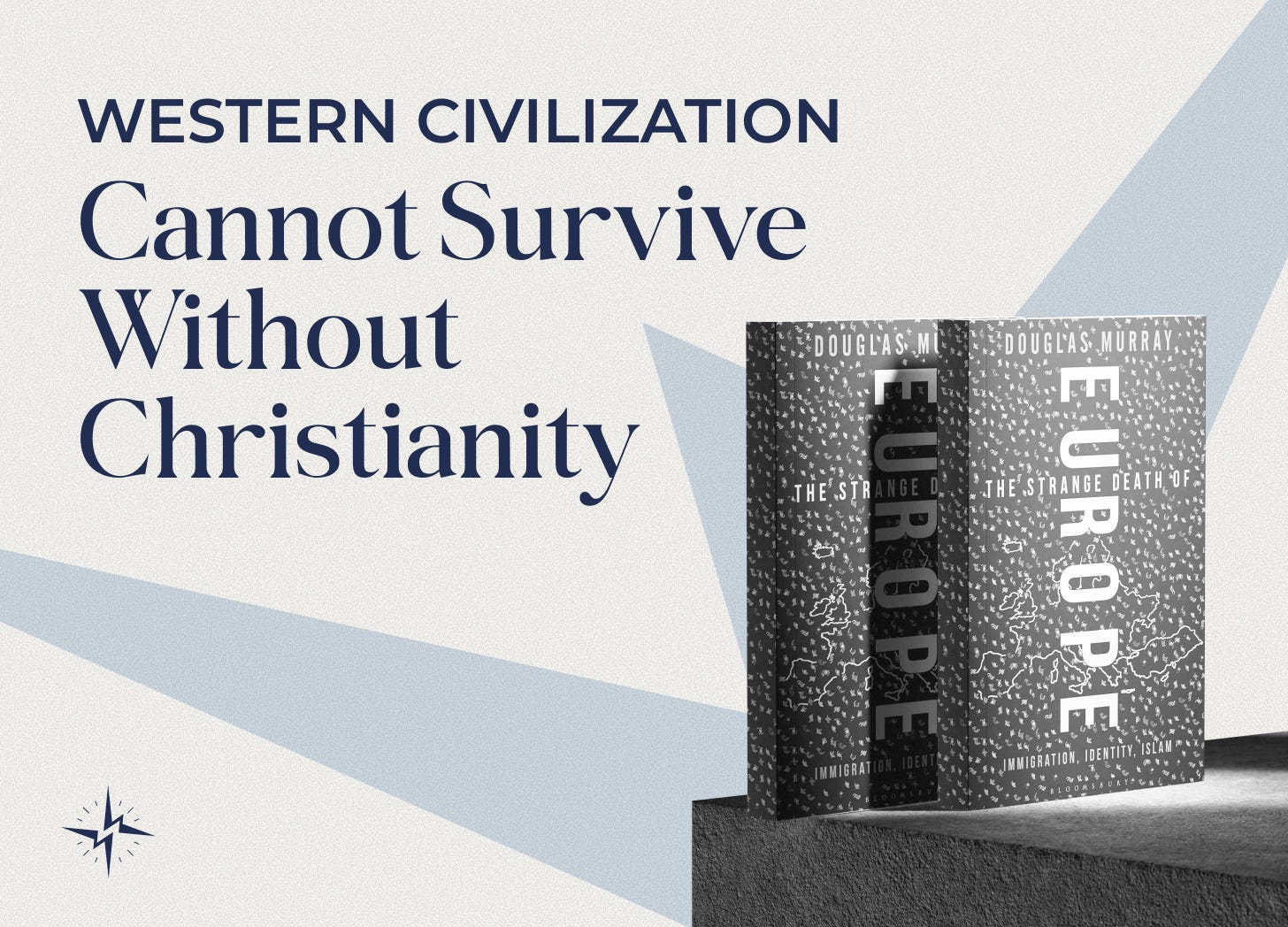
Western Civilization Cannot Survive Without Christianity
Murray rightly warns that a civilization that abandons its spiritual roots cannot long preserve its political freedoms.

Book: The Strange Death of Europe: Immigration, Identity, Islam
By Douglas Murray, London: Bloomsbury Continuum, 2017 • 352 pages
The verdict: This convincing account of Europe's civilizational decline captures why the West will not survive without a revived commitment to Christianity—or, at least, to its values.
WHY THIS BOOK MATTERS
The first step in solving a problem is understanding it. Murray's book is an invaluable contribution to exactly that: understanding what ails the West, and why. Though the U.S. is a bit better off than Europe, Americans can't be complacent as similar signs of decline are undeniable.
THE ARGUMENT
Murray begins with a trenchant claim: “Europe is … committing suicide.” This is mainly due, he says, to two concurrent chains of events. The first is mass immigration. Europe, he writes, has “become a home for the entire world.” Significantly, many of these immigrants follow Islam, whose tenets contrast in key areas with Western Christianity.
The second problem is Europe’s steady loss of faith. While giving classical antiquity and the Enlightenment their due, Murray affirms that Christianity is the primary source of Europe’s beliefs and traditions.
It is key that mass immigration and de-Christianization are occurring at the same time: “the world is coming into Europe at precisely the moment that Europe has lost sight of what it is.” This inevitably leads to crushing change. To survive, Europe must reappropriate its Judeo-Christian heritage and regulate immigration if it has any hope of preserving its social cohesion.
"Unless the non-religious are able to work with, rather than against, the source from which their culture came, it is hard to see any way through."
WHAT WORKS
Murray argues with both mind and heart. He dedicates an entire chapter to Europe’s vanishing “story,” a moving description of many Europeans’ inability to believe in the traditional answers to life’s big questions: “What am I doing here? What is my life for? Does it have any purpose beyond itself?” While bemoaning the “irreversible damage that science and historical criticism have done to the literal truth-claims of religion,” Murray affirms the durable human intuition that we are more than just animals; there is an essential transcendent element to life which cannot be denied. Disregard of this principle has resulted in a “gulf that now exists between the accepted secular-atheist world view of our culture and the reality of how people live and experience their lives.” The denial of transcendent meaning has led to cultural despair. Europe—and all of the West, insofar as it has abandoned Christianity— have surrendered to a civilizationally fatal nihilism.
WHAT DOESN'T
An unbeliever when he wrote this book, Murray fails to consider whether Christianity is true and therefore does not fully appreciate its power. However, he persuasively addresses readers immersed in today’s pervasive secularism, showing that those who value the West can’t afford to disregard the religion that shaped its political and cultural heritage.
Murray’s sketch of a way forward is incomplete in its agnosticism. Nevertheless, it points in the right direction. He argues that “much of the future of Europe will be decided on what our attitude is towards the church buildings and other great cultural buildings of our heritage. … [a]round the questions of whether we hate them, ignore them, engage with them or revere them, a huge amount will depend.”
THE BIGGER PICTURE
This book is not the only jeremiad about a West enmeshed in self-destruction. In 2014, the French essayist Eric Zemmour wrote Le Suicide français (The French Suicide). American journalist Jonah Goldberg’s The Suicide of the West appeared in 2018. Civilizational suicide has rightly become a popular trope; it underscores how serious our predicament is. Murray doesn’t offer easy answers, because there are none. Nevertheless, in its determined honesty, The Strange Death of Europe helps show the way toward restoration. You can’t deal with the problem if you shrink from recognizing how serious it is.
Murray correctly notes that Christianity is unlikely to regain cultural ascendancy in the West anytime soon. For that and many other reasons, restoring the West is the work of a generation at least.
THE BOTTOM LINE
Concerned citizens, cultural critics, and Christians trying to understand the moment will all benefit from Murray’s incisive insights on the state of the West. Murray’s fundamental insight carries weight for people of all faith backgrounds who desire to collaborate toward Western renewal: "Unless the non-religious are able to work with, rather than against, the source from which their culture came, it is hard to see any way through."
Todd Huizinga is Senior Editor of Nation and Citizenship at Restoring the West by Ayaan Hirsi Ali. Follow him on X @Todd_Huizinga.
 | A guest post by
|
I totally agree with Douglas Murray. We need to rediscover our biblical connection and be less narcissistic. Less shopping and worshipping of self and more praying and caring for our country rather than foreigners who hate us, the ones that love our country are welcome.
The Scientific Revolution, the Industrial Revolution and the Human Rights Revolution started and developed in only one place and time - in Europe from the 1500s to the 1800s when it was devoutly Christian. These incredible advances were taken to their greatest heights in the 1900s by America when it was devoutly Christian.
Christianity is the spiritual, intellectual and moral foundation of almost all human progress. No Christianity, no science, prosperity or human rights. This is the most important and clearest lesson of history.